
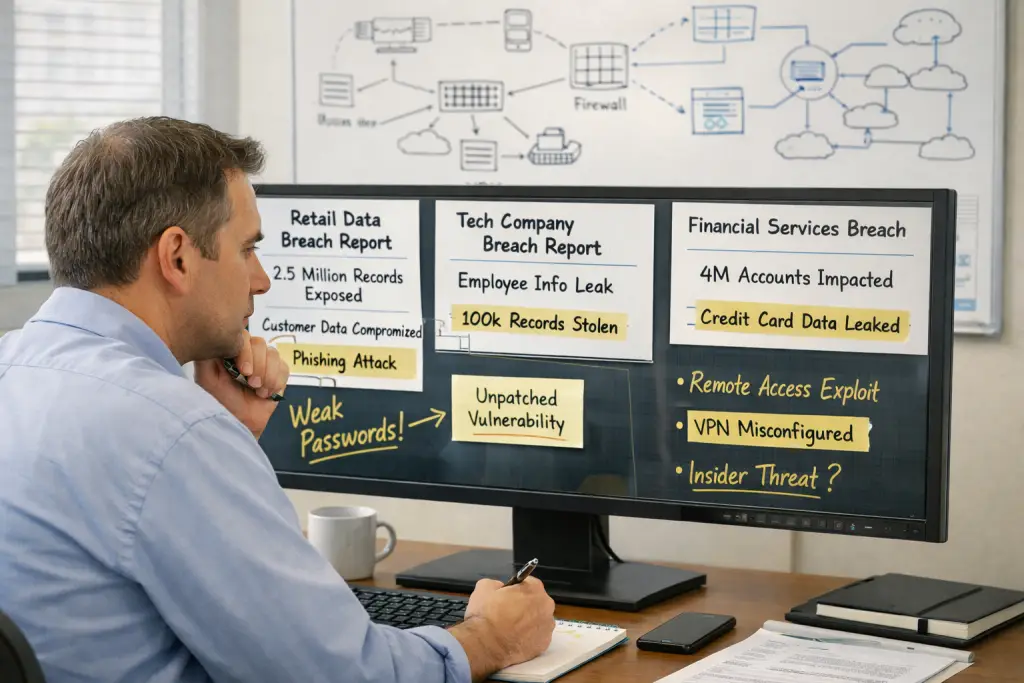
The security community has a gift that we don’t use effectively enough: every major breach becomes public eventually. Companies have to disclose incidents. Researchers analyze and publish findings. Post-mortems get written. We can learn from other organizations’ failures without having to experience them ourselves.
But most people don’t extract meaningful lessons from public breaches. They read the headlines, maybe feel a moment of “glad that wasn’t us,” and move on. Or they read the technical details but don’t connect them to their own environment.
That’s a missed opportunity. Because the patterns that lead to breaches are often similar across different organizations. The attack techniques that work against one target often work against others. The organizational and cultural failures that allowed an incident to happen probably exist in your organization too.
Learning to read public breaches for useful lessons—and applying those lessons to your own environment—is a skill that takes practice. But it’s valuable because it helps you build pattern recognition and intuition without having to learn everything through painful personal experience.
What to Look for in Public Breaches
When you read about a breach, the headline usually tells you what happened: “Company X suffered data breach affecting Y million customers.”
That’s not the useful part.
The useful part is understanding how it happened and why. What weaknesses existed that allowed the breach? What organizational or process failures contributed? What could have prevented it or detected it earlier?
Not all of this information is available. Companies don’t always release detailed post-mortems. But often there’s enough information available—from the company’s disclosure, from researchers who analyzed the incident, from forensic reports if they’re public—to understand the key factors.
Initial access vector. How did the attacker get in? Phishing? Vulnerability in internet-facing system? Compromised credentials? Third-party compromise? This tells you what defenses failed or were absent.
Privilege escalation and lateral movement. Once inside, how did the attacker expand their access? Did they find unpatched vulnerabilities? Exploit weak access controls? Find credentials stored insecurely? This tells you what internal controls failed.
Dwell time. How long was the attacker present before detection? Days? Weeks? Months? This tells you something about detection capabilities—or lack thereof.
What finally triggered detection? Was it internal monitoring? External notification from law enforcement or a third party? A ransom demand? This tells you whether detection worked or the organization got lucky.
Data accessed or exfiltrated. What did the attacker actually get? How was it protected (or not)? This tells you about data security practices.
Response and remediation. How did the organization respond? How long did containment and recovery take? What mistakes were made? This tells you about incident response maturity.
The Pattern Recognition Skill
After you’ve read about enough breaches, you start seeing patterns.
Certain attack paths are common. Phishing to initial access, credential theft, lateral movement through weak internal controls, eventual access to high-value systems or data. This pattern repeats across different industries and organization types because it works.
Certain organizational weaknesses are common. Poor asset inventory leading to unknown or forgotten systems. Inadequate logging making investigation difficult. Over-privileged access enabling lateral movement. Lack of segmentation allowing attackers to reach sensitive systems once they’re inside.
Certain cultural or process failures are common. Security updates that don’t get applied because of operational concerns. Security tools that exist but aren’t properly configured or monitored. Security processes that exist on paper but aren’t followed in practice.
When you recognize these patterns, you can evaluate whether they exist in your own environment. Not “could we get breached the exact same way” but “do we have the same types of weaknesses that contributed to that breach?”
This is more valuable than trying to defend against specific attack techniques. Attack techniques evolve. But organizational weaknesses tend to persist.
Translating to Your Environment
The question to ask when reading about a breach isn’t “could this exact attack work against us” but “what similar weaknesses do we have?”
If a breach happened because of an unpatched internet-facing system: Do we have good visibility into our internet-facing attack surface? Do we have a reliable patching process? Do we know when new systems get exposed to the internet?
If a breach happened because of over-privileged service accounts: Do we know what service accounts exist? Do they have more access than necessary? Have we reviewed them recently?
If a breach happened because logging wasn’t retained long enough to understand the full scope: How long do we retain logs? Is that adequate for investigation? Do we have gaps in what we log?
If a breach happened because a third-party vendor was compromised: How do we assess third-party risk? Do we have visibility into what access third parties have? Do we monitor that access?
This translation from “what happened to them” to “what does this mean for us” is where the learning actually happens.
What Doesn’t Apply
Not every breach lesson is relevant to every organization.
If a breach happened because of a weakness in a specific technology or product you don’t use, the specific technical details might not matter to you. But the category of weakness might still be relevant.
If a breach happened in a highly regulated industry with requirements that don’t apply to you, some of the lessons might not translate. But organizational and process failures often do translate even across different regulatory environments.
If a breach happened at a massive scale and you’re a much smaller organization, some of the systemic issues might not apply. But the fundamental weaknesses often do.
The judgment call is distinguishing between lessons that apply broadly versus lessons that are specific to circumstances you don’t share.
This requires understanding your own environment well enough to make that judgment. If you don’t know your architecture, your access patterns, your third-party relationships—you can’t evaluate whether a particular breach lesson is relevant.
Avoiding Threat Inflation
There’s a risk in reading about breaches: everything starts to look like an emergency.
“This sophisticated attack campaign targeted our industry. We need to immediately implement defenses against it.”
Maybe. Or maybe this is an advanced persistent threat that you’re not actually likely to face, and there are more realistic threats you should be focusing on.
Reading about sophisticated attacks is interesting. It’s good to understand what’s possible. But it shouldn’t drive your priorities unless you have specific reason to believe you’re a likely target for that threat.
Most organizations get breached through common attack paths, not sophisticated novel techniques. Phishing. Unpatched vulnerabilities. Weak credentials. Misconfigurations. These are the things that actually happen frequently.
Sophisticated nation-state attacks make headlines. They’re not what most organizations need to optimize their defenses against.
So when you’re learning from public breaches, pay attention to the common patterns, not just the exotic ones. The boring failures that happen repeatedly are more likely to be relevant than the once-in-a-decade sophisticated campaign.
The Supply Chain Lesson
One pattern that’s become increasingly important: third-party compromise as an attack vector.
Organizations get breached through their vendors. Through their software supply chain. Through their business partners. The attacker compromises an organization that has trusted access to the real target, then uses that access to pivot.
This is hard to defend against because you don’t fully control the security practices of third parties. But you can at least be aware of the risk and take some mitigation steps.
Understand what third parties have access to your environment. What data, what systems, what permissions. Limit that access to what’s actually necessary. Monitor it for anomalies.
Assess third-party security practices as best you can. Due diligence, questionnaires, certifications—these aren’t perfect but they’re better than nothing.
Have contingency plans for what happens if a critical third party gets compromised. Can you disable their access quickly? Can you operate without them temporarily if necessary?
Supply chain risk is one of those lessons that keeps appearing in breach post-mortems. If you’re not thinking about it, you should be.
The Detection Gap
A common theme in breach post-mortems: the attacker was present for a long time before detection.
Sometimes this is because the organization had no detection capabilities at all. More often, it’s because they had detection tools but those tools weren’t configured effectively, weren’t being monitored, or weren’t tuned to detect the specific activity that was happening.
The lesson isn’t “buy better detection tools.” It’s “make sure the tools you have are actually useful.”
Are you collecting the logs that would reveal common attack techniques? Are those logs being analyzed, or just stored? If you’re generating alerts, is anyone actually responding to them or have they become noise?
Detection is only valuable if it actually detects things and if you respond when it does. Having expensive security tools that aren’t properly configured or monitored is security theater.
This is one of those lessons that appears over and over. Organizations that got breached often had tools that could have detected the attack if they’d been properly implemented and used. The failure wasn’t technology—it was implementation and process.
The Organizational Culture Patterns
Some breach post-mortems reveal organizational culture issues that contributed to the incident.
Security teams that raised concerns but weren’t listened to. Security processes that existed on paper but were routinely bypassed because they were inconvenient. Security tools that were deployed to check a compliance box but never actually used.
These are harder lessons to apply because culture change is hard. But they’re important because they reveal that technical controls are only part of security. Organizational culture and process discipline matter just as much.
If your organization routinely prioritizes speed over security, bypasses security reviews, or treats security as an annoying checklist rather than a real concern—you have cultural risk that no amount of technical controls fully addresses.
Reading about breaches that happened partly because of cultural failures should prompt honest reflection about your own organization’s culture.
The Hindsight Bias Trap
When reading about a breach after the fact, it’s easy to think “how did they not see this coming?”
Everything looks obvious in hindsight. The warning signs that were missed, the vulnerabilities that should have been patched, the access that should have been revoked.
But in real-time, with competing priorities and incomplete information and resource constraints, those decisions probably seemed reasonable. Or at least understandable.
This doesn’t mean the decisions were right. But it means you should be humble about judging them, because you’re probably making similar trade-offs in your own environment.
The question isn’t “how were they so stupid” but “what similar trade-offs are we making that might look obvious in hindsight if we get breached?”
That’s uncomfortable to think about. But it’s more useful than smugness.
Putting It Into Practice
The framework I’ve described works best when you see it applied to actual incidents. I write detailed breach analyses at cultivatingsecurity.com/category/analysis that walk through this exact process—taking public breach disclosures and extracting actionable lessons for your environment.
For example, my analysis of the Marquis Software breach examines how a 40-year-old vendor serving 700+ financial institutions appears to have lacked basic security controls like MFA on VPN accounts, adequate logging, and EDR deployment. The piece walks through:
- How the attack unfolded and why it took 74 days for Marquis to notify the financial institutions (their direct customers), then 104 days to notify the actual individuals whose data was compromised
- What the post-breach remediation reveals about control gaps that existed beforehand
- Why standard vendor due diligence failed to identify these issues
- How to translate those patterns to your own vendor risk management
That’s the level of detail needed to truly extract lessons—more than we can cover in this post. If you want to see the framework in action with specific breach examples, those analyses demonstrate exactly how to move from “here’s what happened” to “here’s what it means for you.”
Building Intuition
The real value of learning from public breaches is building intuition over time.
You start to recognize patterns. You develop a sense for what types of weaknesses are common and consequential. You build mental models of how attacks actually unfold in real environments.
This intuition helps you prioritize. It helps you identify risks that matter. It helps you avoid getting distracted by exotic threats that are unlikely to affect you.
It also helps you communicate risk more effectively. “Here’s a recent breach that happened because of the same type of weakness we have” is more compelling than abstract risk discussions.
But building this intuition requires consistently reading about breaches and thinking critically about what they mean. Not just reading headlines—actually understanding what happened and why.
Practical Takeaways
Every public breach is a learning opportunity. Most people don’t extract the useful lessons from them.
Look for how and why breaches happened, not just what happened. Initial access, lateral movement, detection failures, organizational weaknesses.
Recognize patterns across multiple breaches. Common attack paths, common organizational failures, common cultural issues.
Translate lessons to your own environment. Not “could this exact attack work” but “do we have similar weaknesses.”
Distinguish between lessons that apply broadly and lessons specific to circumstances you don’t share.
Avoid threat inflation. Focus on common attack patterns, not exotic sophisticated techniques unless you have reason to believe you’re a target.
Pay attention to supply chain risk patterns. Third-party compromise is increasingly common.
Detection failures are a recurring theme. Having tools isn’t enough—they need to be configured and monitored effectively.
Cultural patterns contribute to breaches. Security processes that exist on paper but aren’t followed in practice create risk.
Avoid hindsight bias. Decisions that look obvious afterward were made with incomplete information and competing priorities.
Build intuition over time by consistently learning from public incidents. This helps with prioritization and risk communication.
Read breach post-mortems not to feel smug but to understand what similar risks exist in your environment and how to address them.
Podcast: Download (Duration: 17:28 — 9.6MB) | Embed
Subscribe to the Cultivating Security Podcast Spotify | Pandora | RSS | More