
Saturday evening. Long day of side projects and farm work. The corporate work week was done, but I’d been grinding through accounting, blog writing, development work—all the side-business stuff that fills weekend hours. I was contemplating just getting out of the house for a while. There was snow in the forecast, but maybe I could run out, grab a pizza at the local joint, have a beer, watch whatever game they had on TV, and maybe even interact with other humans for a bit.
As I was trying to disconnect from my work brain, I was feeding the dogs and bantering with an AI the way I sometimes do—just to break up the day, have fun, and see where the conversation leads. I think I was talking to it about where I should go eat, the snow in the forecast, and the fact that it wasn’t supposed to start until 9 PM. It was only 5 PM—I had plenty of time to get out, relax, and unwind while I waited for the dogs to come back inside.
I tossed out a harmless joke:
You know how weather forecasters are. The only job in the world you can be wrong 100% of the time and still keep your job.
Just weekend humor. But the AI didn’t let it slide.
It pushed back with something like:
The weatherman joke is classic, but honestly, they get more grief than they deserve. Still, you’re not wrong—it’s one of the few jobs where being publicly wrong is just part of the gig. Imagine if your farm accounting had that kind of tolerance for error.
That made me pause.
So I replied:
Yeah, and actually the forecast does help me plan… but in my day job running an InfoSec program, if I’m wrong even once? What do you think happens?
And right there—in the middle of trying not to think about work—I accidentally tripped into the blog post I didn’t know I was looking for.
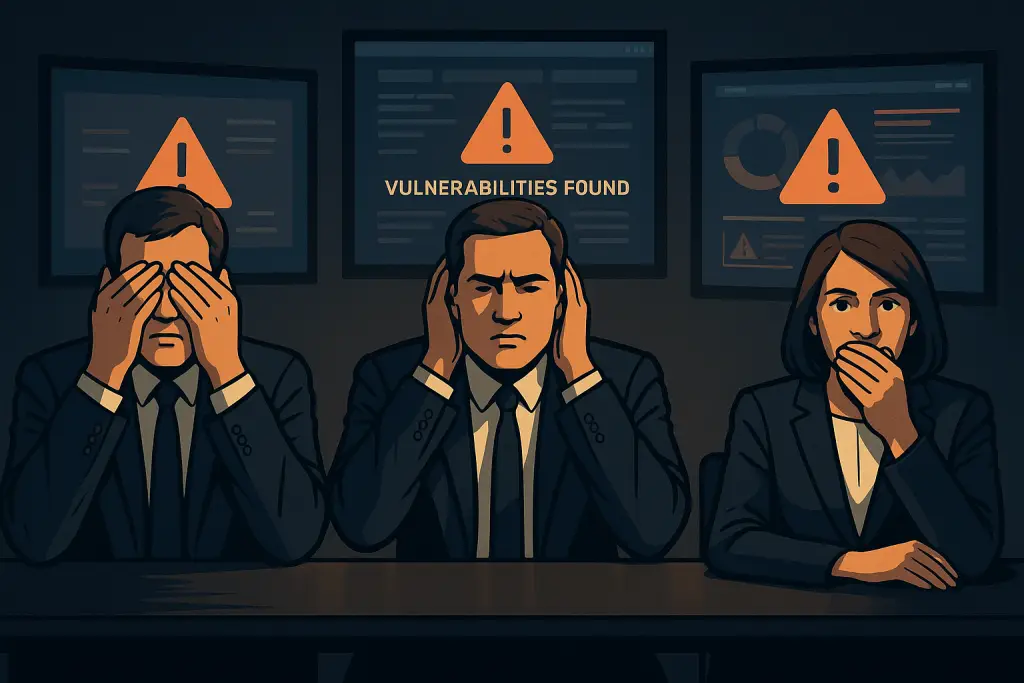
Willful Ignorance—from my perspective and the 20+ years I’ve been in IT and Security, I’m not sure if anyone has really directly talked about this, but I’ve observed it through behaviors and management practices throughout my career. Willful ignorance is when an organization chooses to avoid information that would force them to take responsibility for risk. It’s not about lacking resources or time—it’s about the deliberate decision to stay uninformed because knowing would create uncomfortable obligations.
For those early in their careers, it helps to understand the organizational forces that drive this behavior. Leadership faces competing priorities where security often loses to immediate business needs. Budget constraints create tension when fixing problems costs money upfront. There’s genuine fear of accountability—once you officially know about a risk, you own it. Add in office politics where being the messenger of bad news can hurt your career, and the cognitive discomfort of confronting how vulnerable you really are. Understanding these dynamics helps explain why otherwise smart people make seemingly irrational decisions to avoid security information.
The Weatherman Paradox
Think about how we treat weather forecasts.
Meteorologists are wrong regularly. We joke about it. We expect it. We laugh when they call for sunshine and we get drenched anyway.
But we still check the forecast every single day.
Even imperfect information helps us plan:
- We decide what to wear.
- We adjust outdoor plans.
- We carry umbrellas “just in case.”
- We make informed choices even when the information isn’t perfect.
We recognize something important:
Knowing something—even if it’s uncertain—is more valuable than knowing nothing.
That’s the paradox:
We accept uncertainty in weather forecasting because we know it still improves outcomes.
People choose to know, even when the knowledge might be wrong. This analogy matters because both fields operate in uncertainty—but only one punishes you for being wrong once.
The InfoSec Reality: No Room for Error
Now flip the analogy to cybersecurity.
In InfoSec, being wrong once can be catastrophic.
One missed vulnerability? Ransomware.
One overlooked misconfiguration? Data theft.
One misinterpreted alert? Attackers get weeks of free access.
The 2024 Verizon Data Breach Investigations Report confirms what we see in the field—exploited vulnerabilities now account for 14% of breaches, nearly triple the rate from 2022.
And the math is brutal:
- Defenders must be right nearly 100% of the time.
- Attackers only need to succeed once.
Industry data shows this repeatedly. The Mandiant M-Trends Report documents how initial footholds frequently come from a single misconfiguration or compromised account, often leading to weeks or months of attacker dwell time.
The consequences aren’t “oops, I got caught in the rain.” They’re:
- Operations shut down
- Millions lost to recovery
- Regulatory fines
- Lawsuits that drag on for years
- Reputational damage that haunts an organization for a decade or longer
Despite these stakes, I see the same pattern across industry after industry:
People choosing not to know.
The Dangerous Choice: Willful Ignorance
This isn’t passive ignorance—it’s active.
It shows up in statements like:
- “Don’t tell me about vulnerabilities I can’t fix right now.”
- “We’re too small to be targeted.”
- “We haven’t been breached yet, so we’re fine.”
- “Let’s skip the penetration test this year; things are busy.”
- “We don’t need logging on that system… nothing sensitive is on it.”
Early-career InfoSec professionals encounter this constantly and often blame themselves.
If you’ve experienced this, you’re not alone. It’s real. It’s widespread.
And it’s dangerous.
Willful ignorance manifests when:
- Leadership avoids vulnerability reports
- Business units buy tools without security review because they don’t want to be told ‘no’
- IT teams delay assessments
- Budget committees deprioritize security every cycle
- Organizations decline to implement basic controls like MFA or logging
This isn’t theoretical—Microsoft’s research shows MFA blocks over 99% of credential attacks, yet adoption remains inconsistent across industries:
Why People Choose Ignorance
The psychology of willful ignorance is simple, but it’s backed by research. Behavioral psychology research on cognitive dissonance, motivated reasoning, and willful blindness shows that people often avoid acknowledging security risks when the truth feels inconvenient, embarrassing, or politically costly—making willful ignorance itself a major vulnerability. Knowing creates responsibility.
There’s also a practical reason leadership avoids “knowing” officially. Once you acknowledge a known risk in documentation, meetings, or formal communications, regulatory frameworks and legal liability often increase significantly. Courts and regulators judge organizations more harshly when they can prove you knew about a problem and chose not to act.
Knowing creates responsibility.
If you know your email server is unpatched and exploitable, you now have three choices:
- Fix it
- Accept the risk
- Admit you’re ignoring the risk
Only one of these is comfortable.
So people convince themselves that:
- “If it’s not documented, it’s not a problem.”
- “If we don’t run the scan, we don’t have to explain it.”
- “If we don’t know, we can’t be held accountable.”
But here’s the truth:
Ignorance doesn’t reduce risk. It only reduces accountability—until the breach.
The Fatal Flaw
Here’s what happens when organizations choose not to know and then get breached:
- Attackers stay hidden longer because no one is monitoring.
- Damage spreads further because nothing triggers containment.
The IBM Cost of a Data Breach Report puts hard numbers on this reality: organizations take an average of 204 days to detect a breach and another 73 days to contain it. When the attack involves stolen credentials—the most common attack vector—that timeline stretches to 292 days.
- IR becomes chaotic, expensive, and reactive.
- Recovery takes longer, impacting every business function.
- Regulators and courts judge organizations more harshly when they can prove you knew about a problem and chose not to act—negligence is worse than error.
Organizations that fall into this trap often experience the same painful outcomes—longer breaches, slower detection, and far more damage than necessary—all because the warning signs were ignored.
And here’s the kicker:
“We didn’t know” is not a defense.
Not legally. Not operationally. Not ethically.
The Gap Gets Wider
Attackers study, practice, share techniques, and evolve.
Every. Single. Day.
Organizations that choose ignorance force their defenders to stand still.
Mandiant’s latest research shows attackers now need only 11 days median dwell time to accomplish their objectives, while defenders using traditional approaches can take months to even detect the intrusion.
The gap widens:
- Security teams miss new attack vectors because leadership won’t fund threat intelligence
- They fail to spot early indicators because monitoring tools are “too expensive”
- They’re forced to operate with knowledge gaps because assessments get declined
And you can’t defend against threats when leadership refuses to let you study them.
It’s the organizational equivalent of refusing to let the meteorologist check the weather while storms keep getting more unpredictable.
The Weather Forecast Lesson (Revisited)
Weather forecasts aren’t perfect. They never have been. They never will be.
But we use them anyway because they increase preparedness.
Security information works exactly the same way:
- Reports about new attacks aren’t perfect
- Vulnerability scans miss things
- Pen tests can’t replicate every scenario
- Security tools occasionally throw false positives
But imperfect information still:
- Narrows risk
- Guides decision-making
- Improves detection
- Builds resilience
The right question is never: “Is this information 100% accurate?”
The right question is: “Am I better off knowing or not knowing?”
In security, the answer is always knowing.
What This Means for You
Security practitioners come from all shapes and sizes—companies that are well-funded, excellent management that listens, early-career professionals, or those changing fields. Regardless of your situation, here’s what matters:
This pattern is universal. Willful ignorance shows up everywhere—startups, Fortune 500s, government agencies. The psychology is identical: people avoid knowing because knowing forces action, accountability, and discomfort.
Imperfect information beats willful ignorance every time. You can adopt weather-style thinking in security: directionally correct trumps perfectly accurate, probability beats certainty, and preparedness matters more than prediction.
Learn to identify ignorance as a risk itself. Not knowing isn’t neutral—it actively increases dwell time, blast radius, response costs, and business impact. Recognizing this dynamic is half the battle.
The career skill is diplomatic challenge. Junior analysts who learn to identify and tactfully address willful ignorance—without alienating stakeholders—develop an incredibly valuable capability. You’re not just pointing out problems; you’re helping organizations make better risk decisions.
You now have vocabulary for the frustration. Being able to name what you’re seeing transforms helpless frustration into strategic action. When you can articulate why someone is choosing not to know, you can address the real barriers to better security.
The Real Choice
You can’t control whether you’re targeted.
Modern attackers automate their targeting.
It’s algorithmic, not personal.
The Microsoft Digital Defense Report highlights a 32% surge in identity-based attacks, driven by automated credential theft and infostealer malware operating at scale.
But you can control:
- Whether you’re prepared
- Whether you have visibility
- Whether you understand your environment
- Whether you can recover when—not if—a breach happens
Choosing ignorance because knowledge is uncomfortable doesn’t change the threat landscape.
It only guarantees you’ll be unprepared when the inevitable happens.
And for early-career InfoSec pros:
Learning to identify, communicate, and challenge willful ignorance is a core skill.
Full Circle
That Saturday evening forecast? It called for 2 inches of snow starting at 9 PM.
When I woke up the next morning, there was… barely a dusting.
The forecast was wrong.
But it still helped me plan my evening:
- I dressed for the possibility of snow
- I made decisions with the best information available
- I accepted that uncertainty is part of the equation
That’s how security awareness should work.
Not perfection.
Not absolute certainty.
Just actionable clarity.
And here’s where the analogy really matters for new InfoSec professionals:
We’re not trying to build Fort Knox.
Unlimited security budgets don’t exist.
Perfect security doesn’t exist.
And trying to lock everything down to the extreme just forces people to bypass controls.
We only need to be:
- More prepared than before, and
- More prepared than the organization next to us, and
- Ready to act on imperfect information
This is the art of security:
- Conveying risk in a way people can act on
- Helping leadership understand consequences without paralyzing the business
- Turning imperfect data into practical action
- Making informed decisions under uncertainty
Meteorologists don’t just say “weather is coming.” They give you:
- Probabilities
- Timing
- Severity
- Expected impact
They make imperfect information useful.
We have to do the same thing in cybersecurity.
Because at the end of the day:
Choosing not to know doesn’t make risk go away.
It just guarantees you’ll be unprepared when it shows up.
Podcast: Download (Duration: 15:59 — 8.7MB) | Embed
Subscribe to the Cultivating Security Podcast Spotify | Pandora | RSS | More